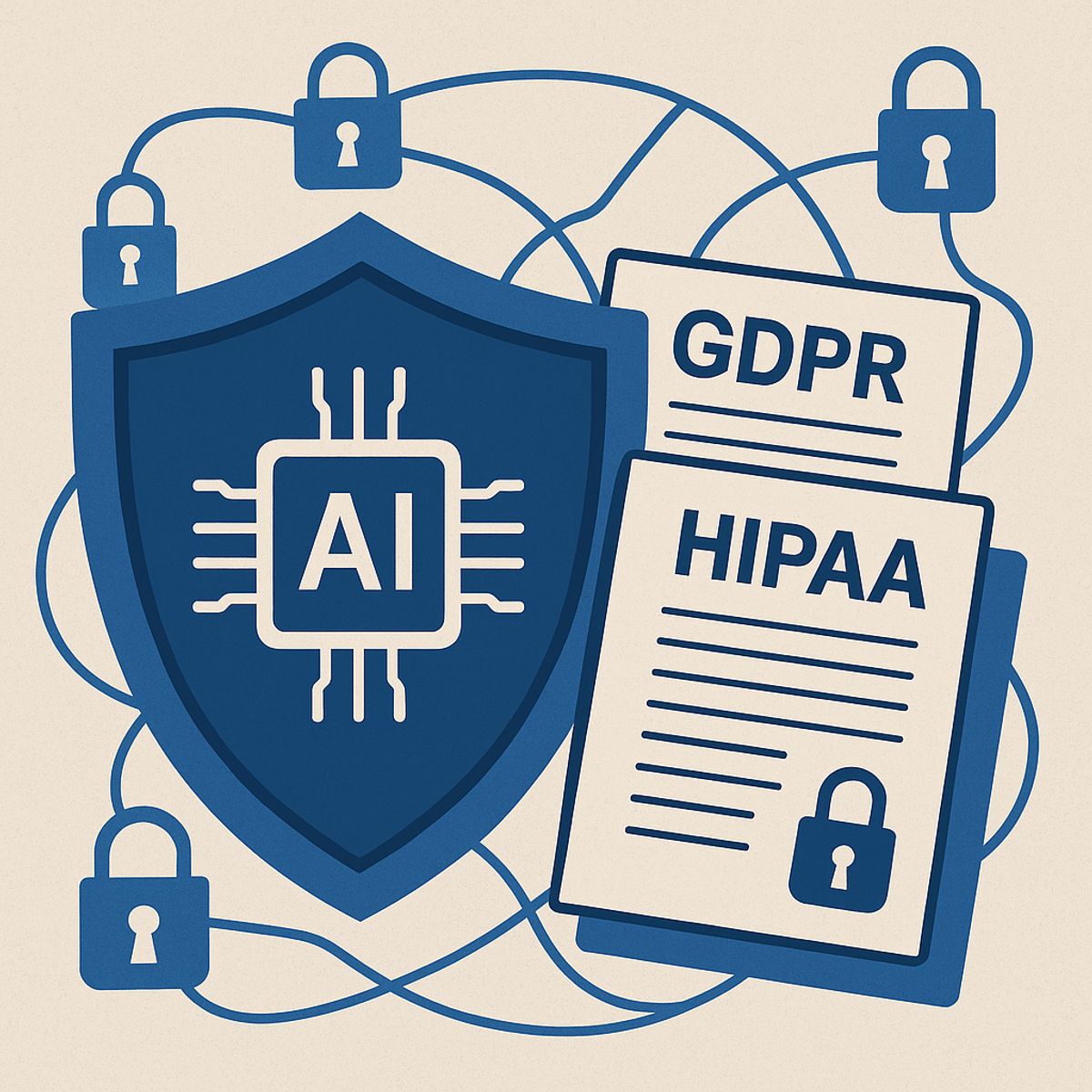
Artificial intelligence is rapidly becoming part of everyday clinical work. Private clinics across the UK and North America are trialling AI receptionists, automated triage tools, clinical decision support, and intelligent EHR integrations. The promise is obvious: smoother workflows, better use of clinician time, and a more responsive patient experience.
But beneath the excitement lies a challenge many clinics underestimate: how to deploy AI safely and legally under the strict privacy rules that govern health data. In the UK and Europe, that means GDPR. In the United States, it means HIPAA. They overlap in purpose but differ in structure, and both introduce serious legal exposure if mishandled.
For clinics hoping to adopt AI confidently, understanding how these regulations apply is no longer optional. It is the foundation on which any sustainable digital transformation must be built.
What GDPR Means for AI in UK Private Practice
GDPR remains one of the world’s toughest data protection frameworks. Health information sits in the highest category of sensitivity, which means any AI that touches clinical data triggers heightened obligations.
Three areas matter most:
1. Lawful, transparent use of patient data
Clinics must be clear with patients about how their data is used, including any automated systems involved in their care. If an AI model analyses symptoms or generates recommendations, the patient has a right to know.
2. Data minimisation and purpose control
An AI tool must only receive the data it genuinely needs. Feeding entire medical records into a scheduling chatbot, for example, would be difficult to justify. GDPR expects clinics to design AI workflows that restrict unnecessary data exposure.
3. Rights around automated decision-making
If an AI’s output might influence diagnosis or treatment, GDPR introduces additional safeguards. Patients can object to solely automated decisions and request human review. Clinics need to ensure that AI augments clinicians - it cannot replace clinical judgement.
Practical GDPR-compliant deployment includes data-flow mapping, Data Protection Impact Assessments, clear patient communication, and strict access controls within AI systems.
What HIPAA Means for AI in North American Clinics
HIPAA is narrower in scope but equally demanding. Any AI handling identifiable health information in the U.S. must meet HIPAA’s Privacy Rule and Security Rule requirements.
1. Minimum necessary data use
HIPAA limits how much patient information an AI system may access. Whether the tool is supporting triage, reading scans, or summarising notes, it must be configured to use the smallest possible dataset.
2. Strong security measures and monitoring
HIPAA requires encryption, access controls, and audit trails. Any AI platform used in a U.S. clinic must log who accessed data, when, and why. This includes AI receptionists and telephone automation.
3. Business Associate Agreements (BAAs)
If a clinic uses an external AI vendor - for example, a cloud-based model that analyses images or transcribes consultations - that vendor must sign a BAA. Many generic AI tools cannot meet this requirement, which instantly rules them out for clinical use.
This is one of the most common compliance pitfalls: clinics assume an AI tool is safe to use simply because it is widely available or encrypted. HIPAA requires much more than that.
Why AI Creates Extra Complexity
AI doesn’t break the rules - but it does stretch them. Health AI systems are often opaque, hungry for data and reliant on cloud processing. This creates challenges in several areas:
Transparency
If an algorithm influences patient care, a clinic must be able to explain its involvement and rationale. Opaque AI systems are difficult to defend under GDPR.
Data governance
AI models may store temporary data, generate logs, or create new derived information about patients. Clinics need full visibility of what is held, where, for how long, and under what legal basis.
Third-party risk
Few clinics build AI in-house. Most use external vendors, which means data leaves the clinic’s four walls. Under both GDPR and HIPAA, that transfer must be rigorously controlled. Contracts alone are not enough - clinics must verify that vendors follow through with appropriate safeguards.
Cross-border data flow
If an AI model runs on servers outside the UK or EU, GDPR’s international transfer rules apply. U.S.-based models also fall under HIPAA as soon as they touch American patients. Clinics operating internationally must ensure the system is legally watertight in both jurisdictions.
These complications aren’t reasons to avoid AI - they are reasons to implement it intelligently and with expert support.
Practical Steps to Deploy AI Safely and Confidently
Over the past few years, a clear blueprint for safe clinical AI deployment has emerged. Private practices adopting AI should expect the following as standard:
1. Privacy-by-design architecture
AI tools must be configured so they only access strictly necessary data. Where possible, pseudonymisation or anonymisation should be introduced, especially for training datasets.
2. End-to-end encryption and robust identity controls
All interactions with an AI system - whether an automated receptionist call or an internal decision-support tool - should be encrypted. Staff access should be role-based and tightly controlled.
3. Full auditability
AI outputs, data access, and system behaviour should be logged. If a regulator or patient requests evidence, the clinic must be able to demonstrate precisely what occurred.
4. Clear patient communication
Patients should know when AI is used, what it does, and how their data is protected. Transparency reduces complaints and increases acceptance.
5. Vendor due diligence
Clinics must not assume that any AI labelled ‘healthcare-grade’ meets GDPR or HIPAA standards. Appropriate contracts, security reviews, and ongoing monitoring are essential.
6. Human oversight
AI should support, not replace, clinicians. Maintaining a human in the loop satisfies GDPR, protects patient safety, and keeps clinical accountability clear.
Why Clinics Need Expert Guidance
Most private clinics do not have in-house AI, cybersecurity, and regulatory teams. Even large organisations struggle to interpret the overlap between GDPR, UK-GDPR, HIPAA, and emerging AI governance guidelines.
This is where specialist support becomes invaluable. At The AI Growth Clinic, we work with private clinics in the UK and North America to build fully compliant, clinically safe, patient-centred AI systems. We design workflows that respect GDPR and HIPAA from the ground up, integrate AI into existing clinical systems without unnecessary disruption, and ensure every tool introduced is legally defensible and operationally sound.
AI will transform private healthcare - but only for clinics that approach it with the right technical and regulatory foundations. Those who implement it safely now will be the ones who benefit most in the years ahead.
Want to deploy AI in your clinic - safely and compliantly?
We’ll help you navigate GDPR, HIPAA, and the regulatory landscape so you can adopt AI with confidence.
Book a Free Discovery Call